


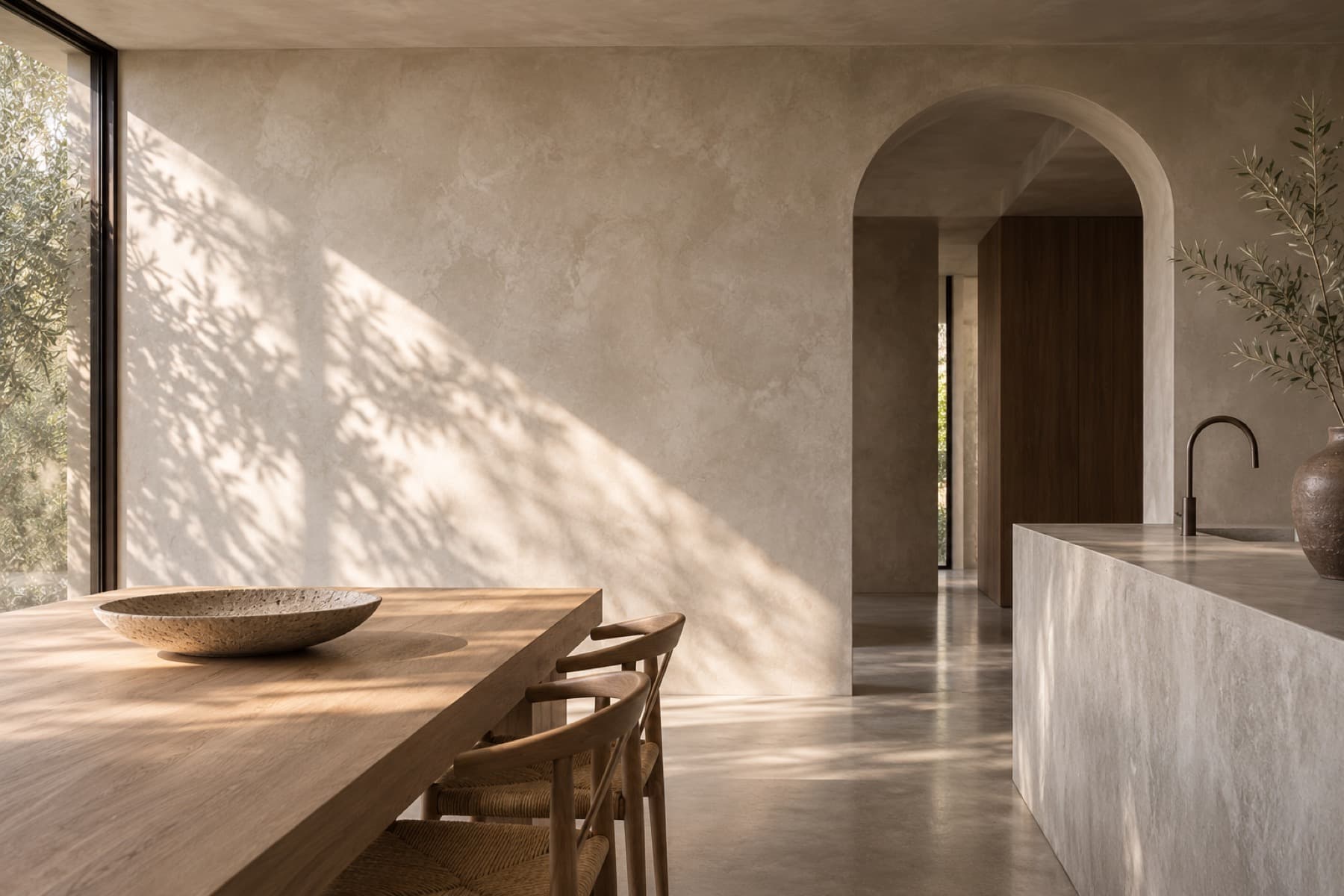
Limewash, mineral paints and the behaviour of light
Conventional paint puts colour on a wall. Limewash and mineral paints put it in one. Nearly everything people notice about these finishes — the depth, the movement through the day, the fact that no two walls come out the same — follows from that.
Two ways of putting colour on a wall
Conventional acrylic wall paint forms a continuous film over the substrate. Its pigment, binder, sheen and surface texture all affect how the finished colour is perceived, but the aim is usually an even, repeatable field of colour.
Traditional limewash is based on slaked lime dispersed in water, with compatible pigment where colour is required. As it cures, the lime carbonates toward calcium carbonate. Applied in thin coats, the finish remains comparatively translucent and materially connected to the surface beneath it.
Silicate paints use different chemistry, commonly a potassium-silicate binder designed to work with compatible mineral substrates or purpose-made preparatory systems. They should not be treated as interchangeable with limewash, even though both can produce distinctly mineral-looking surfaces.
What people often describe as depth comes from several things acting together: translucency, fine surface variation, brushwork, mineral texture and the way raking light reveals those differences. The result is less visually uniform than a conventional painted film.
Why the colour moves
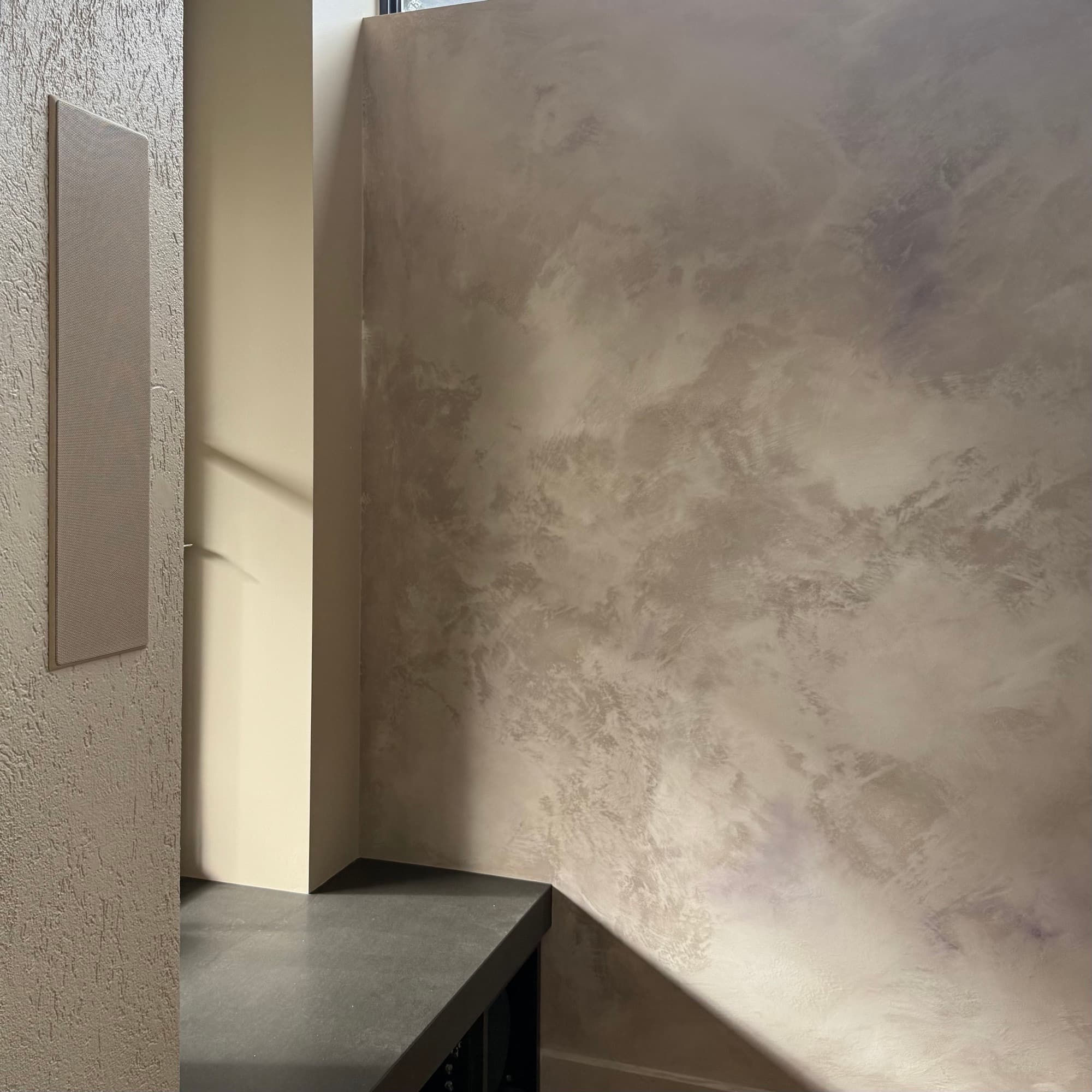
Because the effect depends on light entering the surface, it changes as the light changes. Low afternoon sun rakes across the small irregularities a brush leaves; flat overhead light doesn't. A wall that reads warm and open at four can read cooler and more matte at ten, with nothing changed but the angle.
Application compounds it. Limewash goes on in thin, partly translucent coats, brushed crosswise so no directional pattern sets. Where coats overlap, the layer is marginally denser and reads a little deeper. That variation isn't a defect. It's the finish.
Variation is structural. Remove it and you've removed the reason for choosing the material.
The substrate is part of the colour
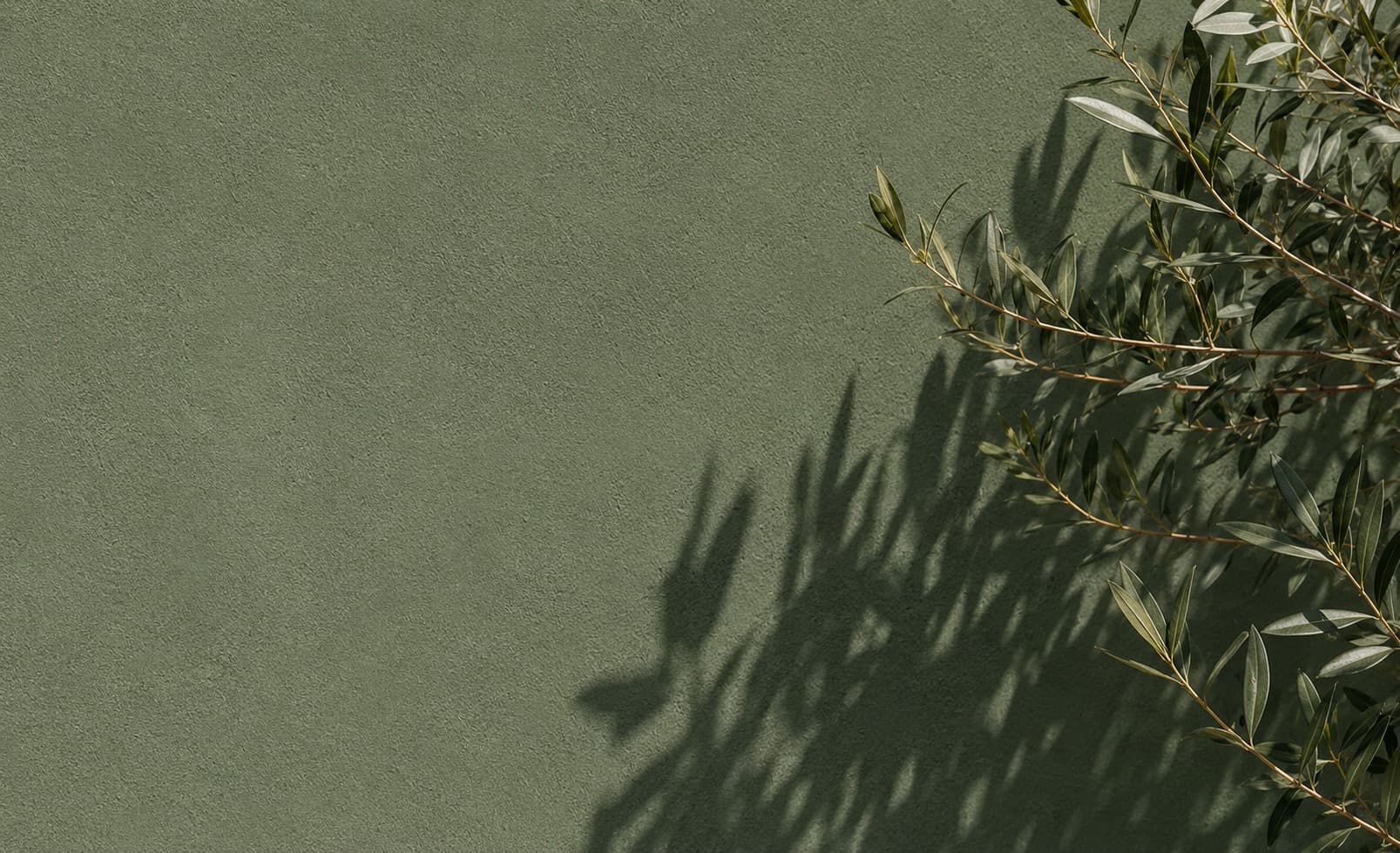
These finishes bond into a surface, so the surface participates in the result. Porosity governs how much material is drawn in on the first coat and how much stays at the face. A more absorbent patch — a repair, a differently finished render, a skim over another backing — pulls more material and dries differently.
So suction has to be evened out before any colour goes on, and the same limewash over two substrates won't give you the same wall. The surface underneath isn't hidden by the finish; it's expressed through it.
Existing acrylic paint changes the specification. Traditional limewash is not simply applied over an acrylic film as though it were bare mineral substrate; compatible proprietary systems may instead use a purpose-made primer or intermediate coat. The correct build-up depends on the particular lime or mineral system being used.
Where they're the wrong choice
These aren't universally better materials, and it's worth being direct about it.
- They aren't washable the way a low-sheen acrylic is. A limewashed wall in a busy hallway with young children will mark.
- They're highly vapour-permeable — an advantage on solid masonry that needs to manage moisture, irrelevant on plasterboard in a dry interior.
- Colour matching is less literal than with a conventional opaque paint system. The final reading depends on substrate, coat build, application and light, so colour is better developed through sampling than treated as a chip-to-wall translation.
- Local repairs and touch-ups need judgement. Depending on the finish, age and application, a repair may integrate more softly than a conventional opaque patch, but it should not be assumed to disappear completely.
Why samples are made in the room
The colour depends on that room's light, that wall's orientation, that substrate, at the intended coat build, seen from where people will actually stand. A sample viewed somewhere else can be misleading.
So samples are made large enough to read as a surface rather than a swatch, applied to the substrate that will be used, and looked at across a full day — morning, afternoon, and under whatever artificial light the room has at night. Then the colour is adjusted and it happens again. Slower than a fan deck, and the only reliable method.
A sample that looks settled at midday can read quite differently at four o'clock. That is the usual reason we leave boards in the room overnight rather than deciding in front of the wall on the day.
This is why SURFACE develops specialty finishes for a specific space rather than supplying them from a range — the sampling isn't a formality before the work, it's where the finish is decided. Some of what that process has produced is in our specialty surface treatments. If you're considering limewash for a particular room, tell us about the space and the light it gets.
Related reading