


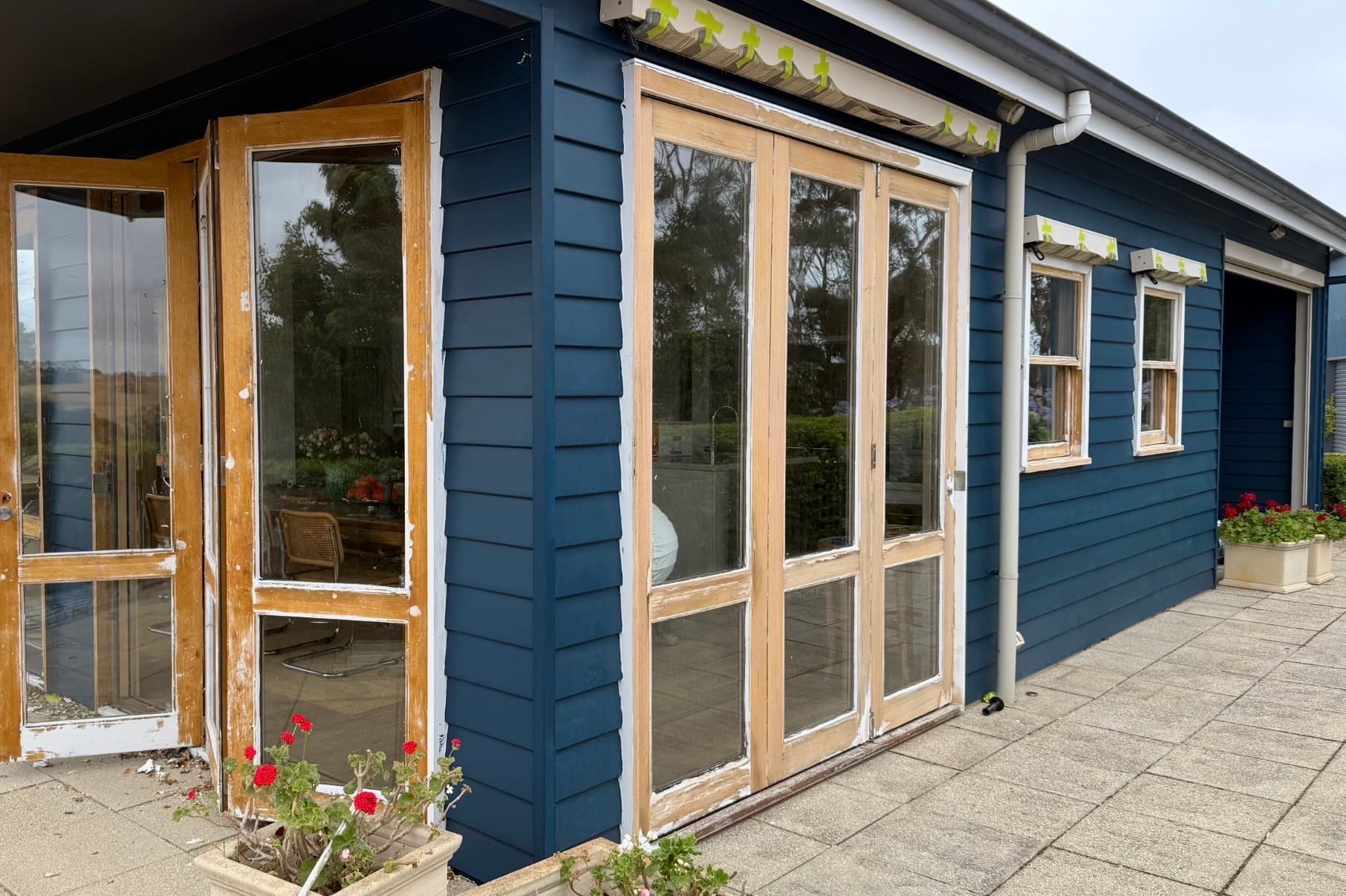
Timber stripped back before recoating. The previous film had let go at the edges and joints — the places water reaches first.
Why preparation determines how a painted surface ages
Paint failure often begins somewhere beneath the finish coat. It fails at one of the joins beneath it — where coating meets substrate, where one coating meets another, or inside a layer that had already given up. The finish coat is the part everyone sees, but much of its longevity is decided before it goes on.
The three places a coating lets go
Between coating and substrate. The new film never bonded — applied over a contaminant, a chalked or dusty surface, a glossy surface with no key, or timber that was too wet. It comes away cleanly, often in sheets, and the back of the flake is smooth.
Between one coating and another. The new film bonded to the old, but the old had lost its own grip, or the two were incompatible. This is the case people misdiagnose most often, because the top coat looks fine right until a whole stack of layers lifts together.
Within a degraded layer. Nothing debonded — the material itself broke down. A heavily chalked surface fails this way: the new coat holds perfectly to a layer of loose pigment that is no longer holding to anything.
All three can be influenced by what is found and dealt with during preparation, and much of that work becomes invisible once the finish is on.
Chalking, and why washing isn't cosmetic
UV degrades the binder in an exterior coating from the outside in. As it breaks down, pigment that was held in the film is released as a fine powder. That's chalking - a common form of weathering in exterior coatings rather than, by itself, proof of an application fault.
The problem is what it means for recoating. Paint over chalk and you've bonded the new film to loose material. It will look right, and it will fail at the chalk layer. So the surface gets washed back to sound coating and, if chalking is heavy, sealed with a primer formulated to bind a chalky substrate.
Washing also deals with what's simply sitting on the surface — dirt, biological growth, and near the coast, deposited salt. Biological growth needs to be properly removed and treated in accordance with the coating system rather than simply painted over.
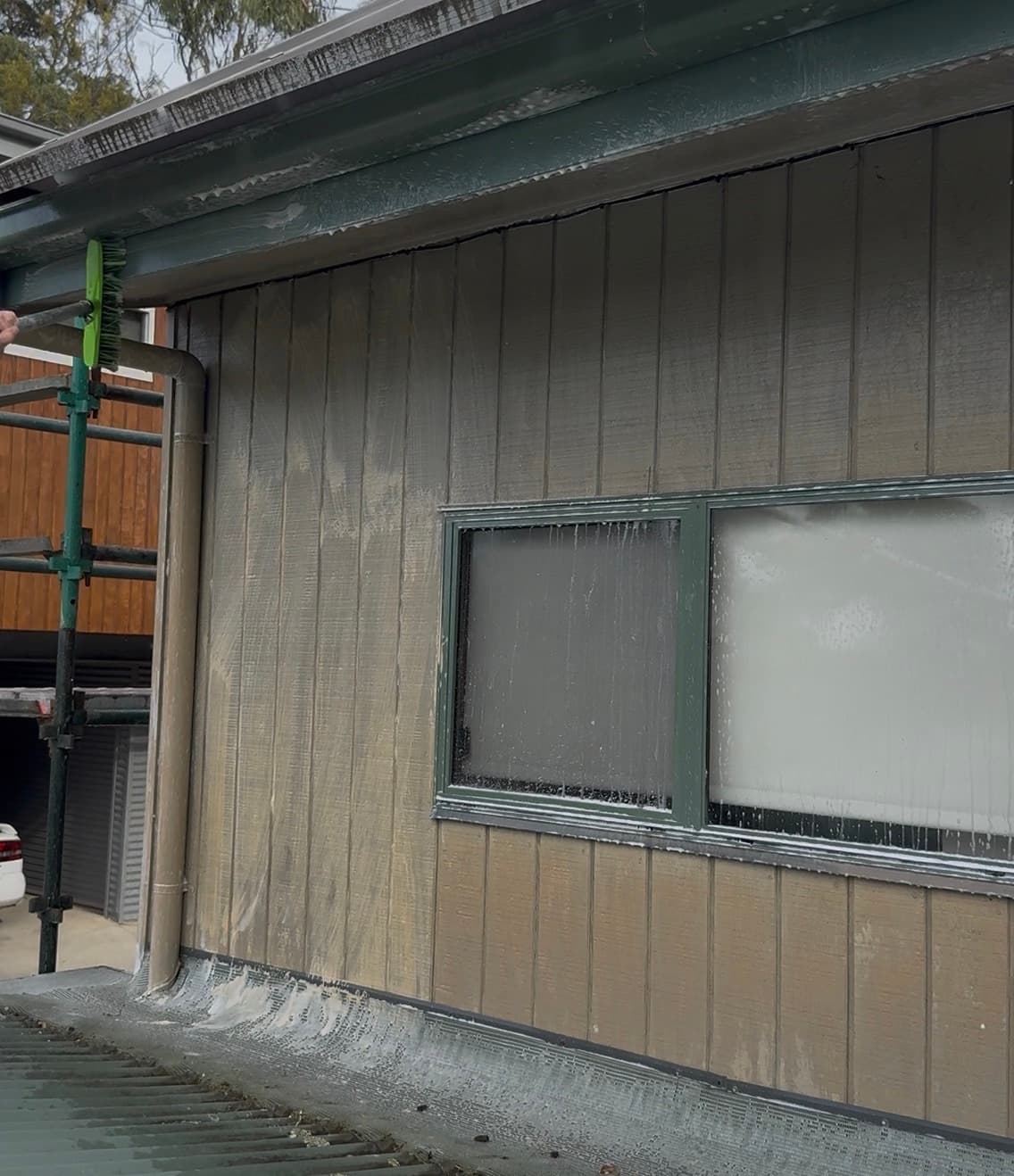
The surface has to be sound before it can be made to look good. Two problems, in that order.
Moisture is a timing problem
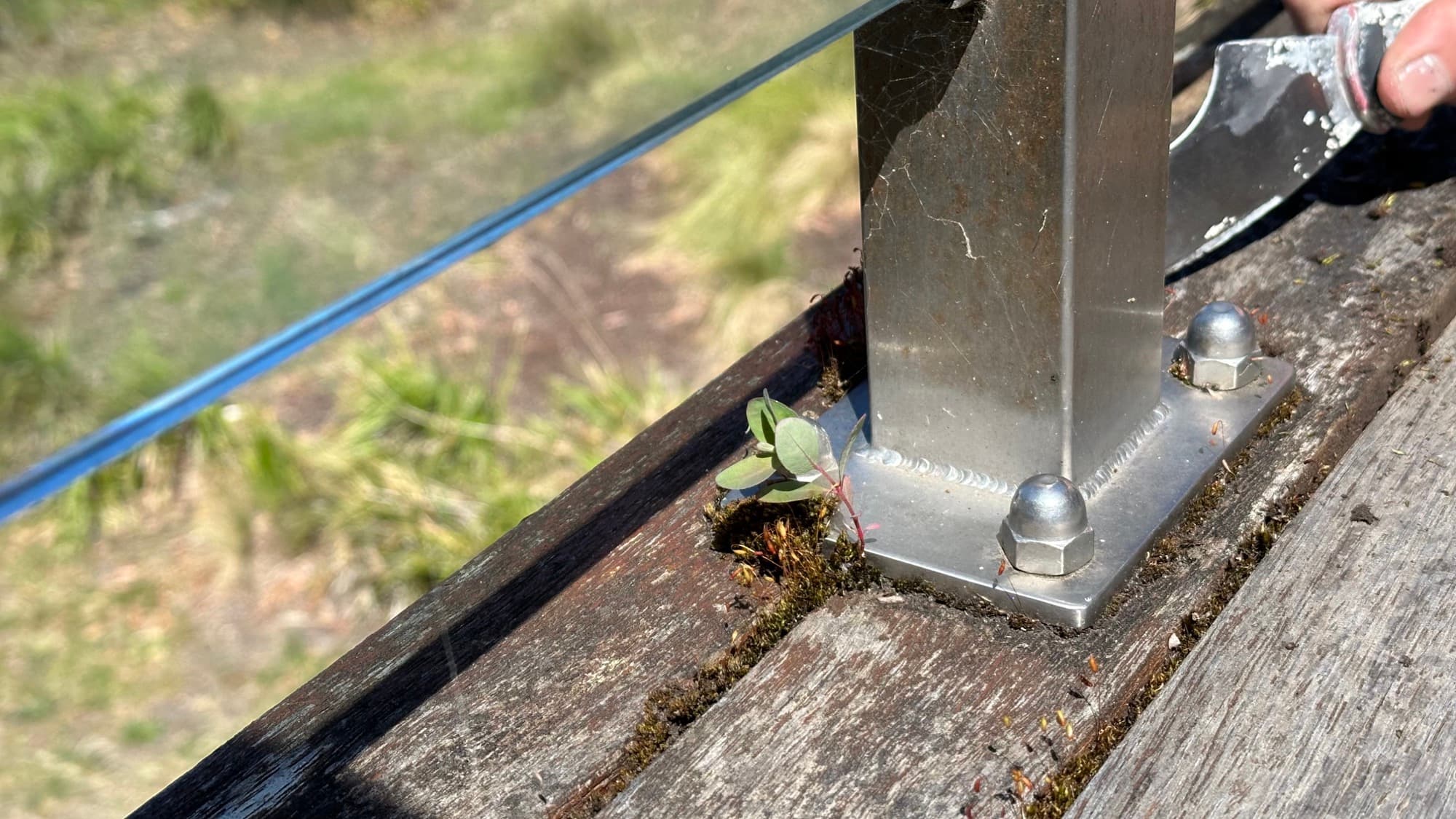
Timber takes up and releases moisture with its surroundings. Coat it while it's carrying more water than it will hold in service and that water is sealed in behind a film, where it drives adhesion failure and can support decay in the timber itself.
Which is why exterior timber work depends on more than whether it's raining today. Cladding that looks dry can still be well above a workable moisture content after a wet week, and the honest answer is sometimes to wait.
Sanding does two different jobs
Sanding gets described as one operation. It's two, and confusing them causes problems.
The first is removal — taking off degraded coating, feathering the edges of failed areas so the transition doesn't telegraph through the finish. The second is keying — giving a sound but glossy surface enough profile for the next coat to grip. Different grits, different judgement about when to stop. Over-sand a sound surface and you've removed protective film for nothing; under-sand a glossy one and the bond depends entirely on the primer.
Filling, and the movement afterwards
A filler has to do more than sit flush on the day. It has to move roughly as the surrounding material moves, and take the coating the same way.
A rigid filler in a timber joint that opens and closes seasonally will crack or push out, and the crack reads straight through the finish. A filler more absorbent than the surface around it pulls more coating and flashes differently, showing as a patch in certain light even when the surface is perfectly flat — which is why filled areas get spot-primed rather than left for the finish coats to even out.
What can go over what
Not every coating can go over every other — hard films over softer ones that keep moving, some solvent-borne systems over water-borne films, coatings over surfaces never designed to receive them.
On an older house the existing system is usually unknown. The answer is to test rather than assume: testing a small inconspicuous area can expose adhesion or compatibility problems that are not obvious from visual inspection alone.
The same logic produces different work depending on the substrate. Timber turns on moisture content, end grain and movement. Render and masonry on alkalinity, moisture from behind and soluble salts. Interior plaster mostly on soundness and sheen. Steel on corrosion under the film, which has to be removed rather than covered. A specification that treats these identically isn't a specification — it's a habit.
The most common surprise on an older house is a topcoat that looks perfectly sound sitting over an older layer that has already let go beneath it. Nothing about the surface gives that away until it is tested.
Most of this is invisible in the finished work, which is exactly why it's where corners get cut. It's the part of house painting that decides how a surface looks in five years rather than five weeks. Where preparation shows a coating has gone too far to recoat, the work becomes surface restoration instead — a difference visible in our before and after work.